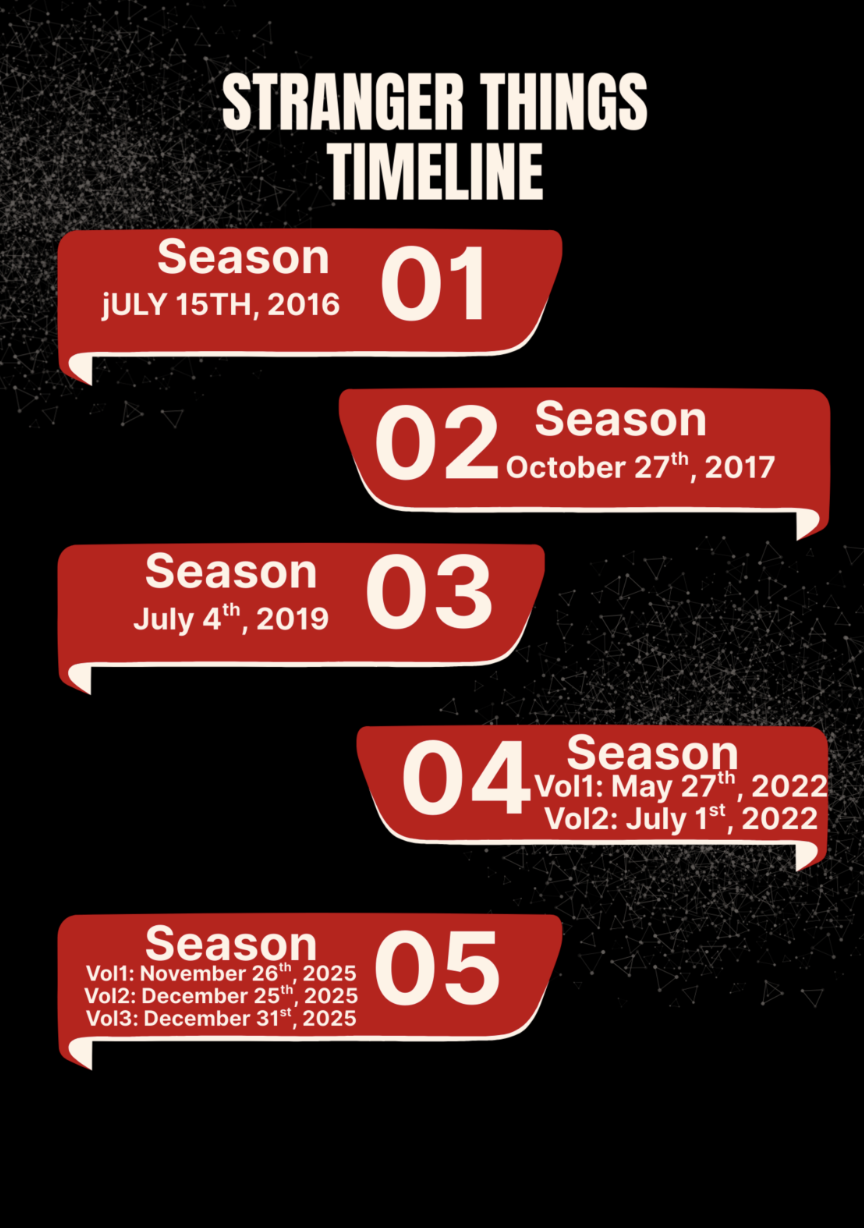
For nearly 10 years, Stranger Things was not just a TV show but a shared experience. It was something people grew up with, theorized about online and waited years to see finished. Since its debut in 2016, the series became one of Netflix’s biggest successes, blending science fiction, horror and coming-of-age storytelling with the unmistakable influence of the 1980s. The show’s bikes-on-empty-roads aesthetic and references to Cold War fears turned Hawkins into a symbol of both nostalgia and unease. By the time the fifth and final season premiered in November 2025, expectations were incredibly high. Fans were promised a conclusion that would tie together years of buildup, character arcs and unanswered questions. Instead, when the finale aired Dec. 31, many viewers were left feeling disappointed, confused or conflicted.
According to Netflix’s year-end engagement report, Stranger Things Season five earned 59.6 million global views in its first six days, making it the biggest English-language premiere week in Netflix history. Season five alone drew tens of millions of viewers in its first week and dominated online conversation. However, popularity did not translate to universal approval. Almost immediately after the finale aired, social media platforms filled with criticism questioning the pacing, writing choices and overall direction of the ending.
A final season that felt rushed
One of the most common complaints about Season 5 was that it felt rushed. Earlier seasons of Stranger Things took their time developing tension and character relationships. Emotional moments were allowed to linger, and the slow-burn mystery was part of the show’s appeal. In contrast, the final season compressed numerous major events into a short span of episodes.
Key conflicts were introduced and resolved rapidly, sometimes without giving characters or viewers time to fully process them. Scenes that should have felt impactful moved on quickly, replaced by the next plot point. The result was a season that felt more concerned with reaching the ending than earning it.
“I think the fan theories were way better than the actual execution of the plot in the show,” said Aryana Sharabyani, 11.
Rather than feeling intentional, the pacing made the story feel incomplete. For a show once praised for its emotional depth and careful buildup, Season five often felt surprisingly shallow.
Plot holes and loose ends
Another major criticism centered on plot holes and unresolved storylines. Across earlier seasons, Stranger Things rewarded careful viewers with long-term foreshadowing and callbacks. Season five, however, left several questions unanswered. Explanations surrounding the Upside Down, Vecna’s origins and the rules of the show’s universe were either vague or ignored altogether.
Some storylines that had been emphasized for years seemed to disappear without resolution. For the final season, this lack of closure stood out. Viewers were not asking for everything to be neatly explained, but many felt that important narrative threads were abandoned rather than intentionally left open.
Conformity Gate theory
One of the most widely discussed fan theories to emerge after the finale was the “Conformity Gate” theory. Rather than predicting future events, this theory argued that the ending itself was an illusion. According to Conformity Gate, the Season five finale was not real, and the audience was still metaphorically trapped under Vecna’s curse.
Supporters of the theory pointed to how disconnected the ending felt. The rushed pacing, unresolved arcs and strangely tidy conclusions were interpreted as signs that viewers were being deceived. In this interpretation, Vecna’s greatest power is manipulation, convincing people to accept a false sense of closure. Fans believed the Duffer Brothers intentionally misled audiences by releasing an incomplete ending while secretly writing a second, real conclusion that aligned with years of foreshadowing.
Online, some fans speculated that this hidden ending would eventually be released. However, as time passed and no alternate finale appeared, the theory remained just that. Still, the popularity of Conformity Gate reveals how deeply unsatisfied many viewers were. Rather than accepting the ending as canon, fans searched for explanations that made the flaws feel purposeful instead of accidental.
The missed potential of Byler
Perhaps the most emotionally charged debate surrounding Season 5 involved the relationship between Mike Wheeler and Will Byers, commonly referred to as “Byler.” Across multiple seasons, fans noted repeated moments of emotional intimacy, lingering looks and dialogue that suggested romantic subtext. Many interpreted this as deliberate foreshadowing.
Season five failed to provide clarity. The relationship remained ambiguous, leaving years of buildup without resolution. For many viewers, this felt less like subtle storytelling and more like avoidance. The issue was not whether Byler became canon, but whether the show followed through on what it repeatedly implied.
There is also a larger issue at play. It feels unfair that queer characters’ endings so often center on self-acceptance and quiet endurance rather than being granted the love and happiness their straight counterparts receive. Once again, a queer character’s arc concluded with personal growth instead of mutual fulfillment. For some fans, this reinforced concerns of queerbaiting, where representation is teased but never fully realized.
“I was honestly pretty disappointed when Byler didn’t happen,” said Grace Fasulo, 11. “I think representation in a big show like Stranger Things is important, and in my opinion it was heavily hinted at in the seasons prior. Although I do also like the fact that Will was able to realize that Mike didn’t need to be his deciding factor of his sexuality.”
When a show spends years hinting at a relationship, choosing not to resolve it in the final season feels less like restraint and more like a missed responsibility.
Online backlash and cultural impact
The reaction to Season five was amplified by social media. Within hours of the finale’s release, criticism trended worldwide. Fans posted reaction threads, video essays and detailed breakdowns explaining why the ending felt unsatisfying. While some viewers defended the season, a significant portion expressed disappointment.
Notably, much of the backlash came from longtime fans. This was not rejection, but frustration. Viewers who had grown up with the show felt let down by an ending that did not reflect the care of earlier seasons or fully honor the series’ 1980s-inspired themes of friendship, rebellion and emotional honesty.
A complicated legacy
Despite its flaws, Season five does not erase Stranger Things’ cultural impact. The show helped define an era of streaming television, revived interest in 1980s aesthetics and created characters that became household names. However, endings matter. A finale reframes everything that comes before it.
For many fans, the final season introduced a disconnect between the show’s potential and its execution. The rushed pacing, unresolved arcs and controversial narrative choices made the conclusion feel functional rather than purposeful. It closed the story, but it did not fully satisfy it.
In the end, Stranger Things Season five serves as a reminder that storytelling is not just about reaching the finish line, but about how thoughtfully the journey concludes.