
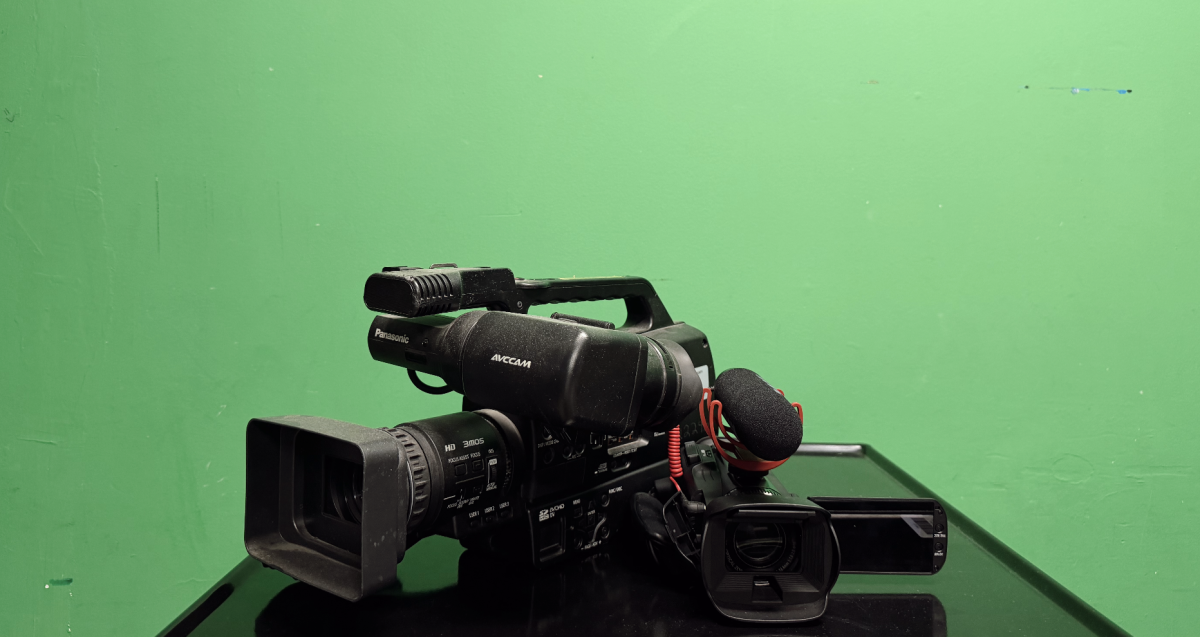
Television, TV, Production is more than simply a class at Plant; it is an institution. TV Production has been an option for students at Plant for over a decade and has gone through waves of providing the student body with a morning shows edits of sports games and interviews of students around the school.
How has a class such as this complete this amount of work in the school year?
To prepare for the wide variety of skills it takes to be a member of the TV Production team, students go through the path of learning how to do what it takes.
Plant offers four levels of the TV Production class, TV 1, TV 2, TV 3 and TV 4. These classes ascend in their difficulty and slowly teach their students the skills necessary to be successful as a member of the TV Production team.
“I began in TV 1 doing quizzes on parts of a camera and compositions of a video and photos and things of that nature,” Sophia Ventura (11) says. “Now that I am a part of TV 3, I go to games, especially football when it is in season, on my own, get the footage and edit it to be posted on all of the social medias.”
Ventura has graduated from creating edits for solely TV Production and now uses her learned editing skills to produce her own edits and sell her skills and products.
“I sell a lot of my edits to Mannaz Desgins and make enough extra money to supplement my needs,” Ventura says.
The teacher behind teaching all of these students there skills throughout their high school career is none other than Greg Meyer.
Meyer has taught Plant TV Production for 12 years at all levels.
“TV Production is one of the only reasons I am still in education,” Meyer says. “The favorite part about it has to be the students and the actual lessons they get to learn from this class.”
The kids share the same affinity for Meyer as Meyer does for them.
“Meyer is by far my favorite teacher,” Grace Gordin (11) says. “He is understanding, kind and still finds a way to educate us without being demeaning.”
Meyer has his own philosophy concerning what it means to be a teacher which creates bonds with his students, unlike others at the school.
“It is a creative outlet, and more is about performance and demonstrating their own proficiency as opposed to a score on a test,” Meyer says. “It is a working art and an evolution. Where some kids take weeks, others take months, and it is all a beautiful process regardless of the speed.”
Olivia Menard (11) commented on how TV Production provided a home for her at Plant.
“I moved to Tampa my freshman year and getting to be a part of a community that was so fostering was incredibly important for my transition,” Menard says. “I now report on most of the sports games and see a possible future career in it all because of Meyer and this class.”
As seen by student accounts, TV Production is a home for many at Plant. Many are even aware how it is an open space for those that are his students and those who are not.
“I have never been a part of TV Production, but I go in there sometimes with my friends and I never feel not included from anything,” Jaden Turek (11) said. “It is a very inviting space.”
Another student who is not a member of the TV Production team continued with the same notion. Kathryn McAteer (11) is a part of the yearbook staff and collaborates with TV Production for photos and quotes occasionally.
“I run in there sometimes for quotes and questions, and it has always been a positive experience in the past,” McAteer says. “I don’t do it much anymore, but I still really enjoy Coach Meyer as a person.”
Ultimately, Meyer completed his goal of creating an open and inviting space where students could grow and develop as members of the TV Production community.
“Some kids take a little bit of more time but helping them get through all the phases is much more enjoyable than trying to teach them any random curriculum,” Meyer says.
Diagram of Coach Meyer’s Desk by caporcelli