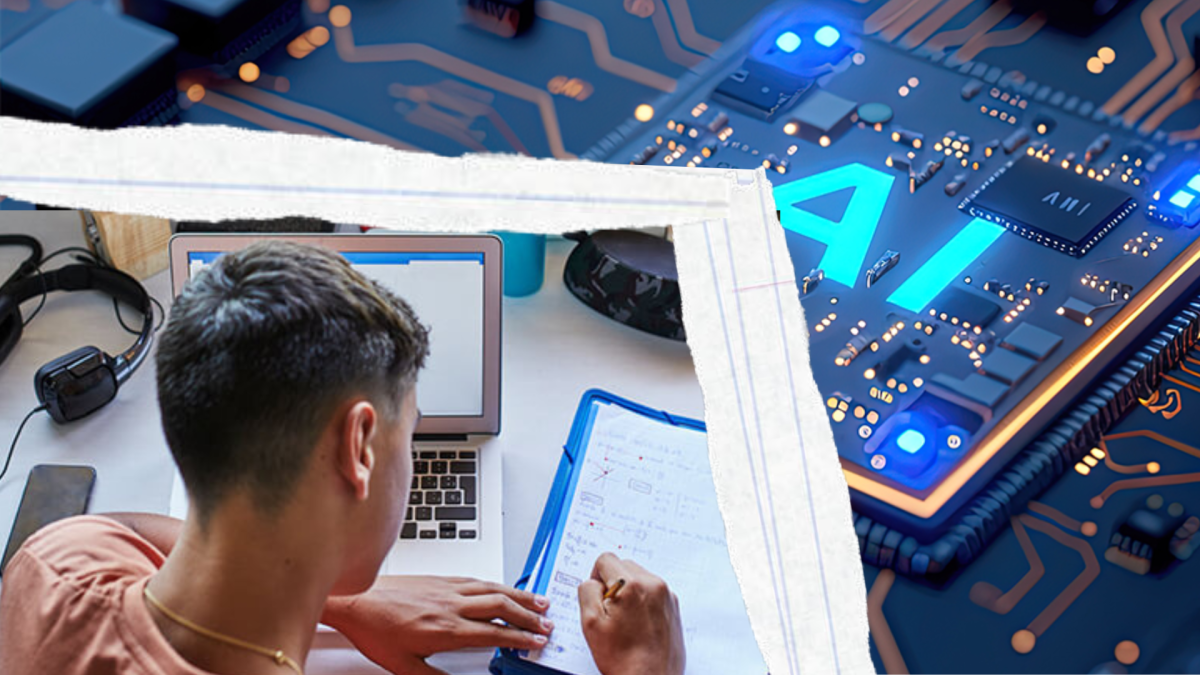
Picture this: it is 2022, students are barely able to keep up with homework, hours upon hours are spent every night as AP classes slowly increase their workload each year. Since the pandemic, students have also had to deal with the added stress of online assignments, pushing workloads to levels never seen before. Students have never been so burdened by their work.
Then ChatGPT was released to the public.
Students are instantly given a solution to their endless homework. Got a math question? Easy. Got an essay due in 10 minutes? Piece of cake. Best of all, teachers cannot even tell. They see work that looks better than what students usually produce in class, even though it is not actually theirs. Naturally, most students view this tool as salvation from their near-infinite pile of homework.
“In junior year, I was easily spending at least four or five hours on homework every night, if I was lucky,” Katherine Arnold, a senior, said.
However, AI has serious negative environmental impacts. It uses massive amounts of water that cannot be reused, and AI servers produce as many carbon emissions as New York City. Students, of all people, are some of the most aware of these effects. Most students can agree that using AI is technically bad, yet many brush it off because they do not want to sacrifice their physical and mental health doing work they believe will not benefit them.
“I’d rather deal with the guilt that I’m melting Antarctica than do work for any AP class on my own,” Adriel Nuñez, a sophomore, said.
Beyond environmental damage, repetitive use of AI can lead to dependency. Even when students reach college and have less busywork, they continue using AI to make assignments easier, relying on the same tools that carried them through high school. In college, however, assignments matter far more to actual learning. This could result in graduates who are technically qualified but lack real knowledge.
So what is the alternative for students?
AP classes can assign hours of homework every night. When combined across multiple classes, students may have to pull all-nighters for several days just to earn an “A.” Who wants to live like that? As a result, AI becomes a necessity rather than a choice.
This problem can be fixed. If teachers assigned less homework and were given clearer guidelines on how much homework they are allowed to give, students would not have to rely on AI. With manageable workloads, AI use would naturally decrease.
Students do not want to use AI. They feel forced to.
These guidelines would solve multiple problems at once by reducing AI use and its environmental impact while also improving student morale, mental health and overall well-being.
In the end, when a student uses AI for homework, do not immediately call them out. In many cases, they are not being lazy. They are simply trying to preserve their sanity.
CLICK HERE TO READ FURTHER ABOUT AI CARBON EMMISONS:
CLICK HERE TO SEE RESULTS OF A SURVEY ON STUDENTS AI USE:
https://research.collegeboard.org/media/pdf/AI%20Research%20Brief%201_vf_0.pdf