
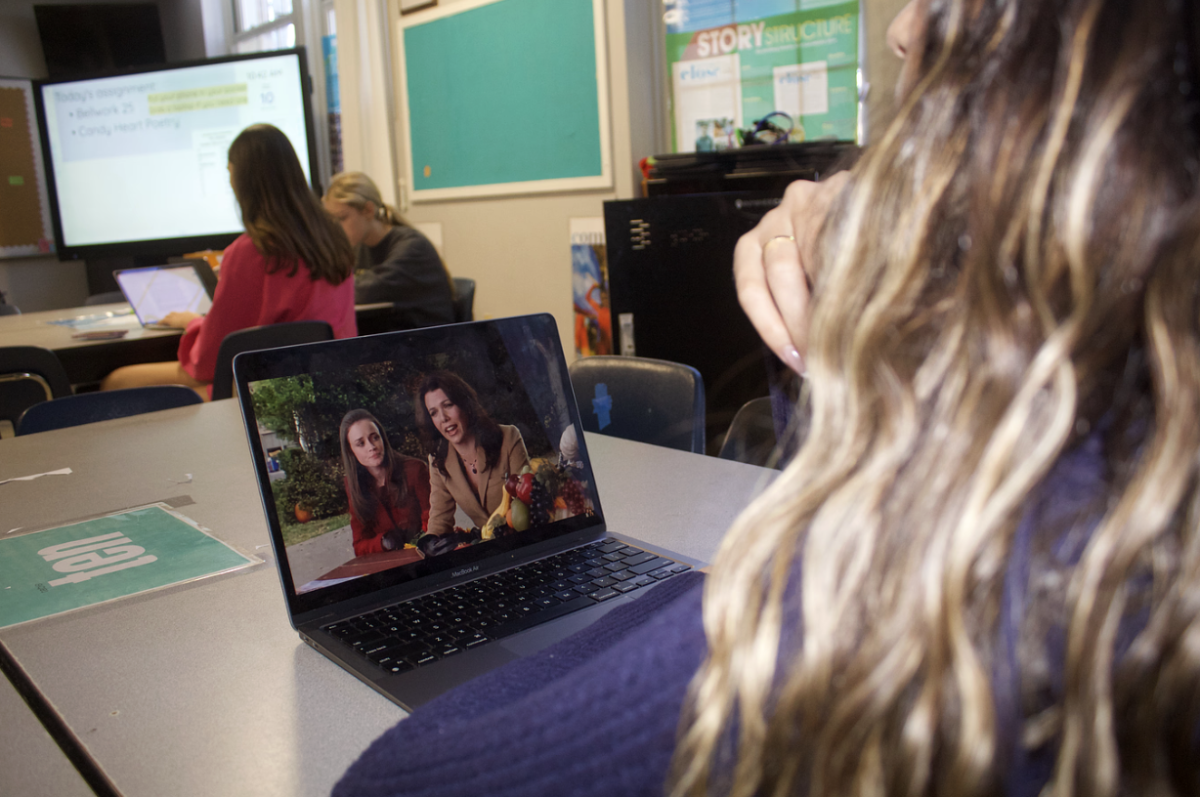
Gilmore Girls first aired in 2000, but the show continues to resonate with new audiences because of its honest portrayal of growing up. At the center of the show is Rory Gilmore, a character whose evolution over seven seasons reflects the messy, nonlinear process of moving through different stages of life. While Rory is often debated online as either a role model or a disappointment, her development becomes clearer when viewed as a reflection of shifting priorities, pressures and identities across adolescence and early adulthood.
In the early seasons, Rory is introduced as the idealized “good kid.” She is academically gifted, polite and deeply motivated, particularly after she begins attending Chilton. Her world revolves around achievement and external validation, mirroring the experience of many high school students navigating competitive academic environments. Rory’s sense of self is closely tied to success, especially academic success, and to the approval of authority figures. This version of Rory represents a season of life defined by ambition, discipline and the belief that hard work guarantees positive outcomes (Feuer, 2000).
As Rory transitions to Yale, the series complicates this narrative. She is no longer the standout student in every room, and her confidence begins to fracture. Rory struggles with failure in ways she has never experienced before, including criticism from professors and uncertainty about her future career. These challenges reflect a common stage of life when structure fades and self-doubt increases. Media scholars note that Gilmore Girls portrays Rory’s college years as a period of identity questioning rather than steady progress (Mittell, 2015). Her discomfort underscores the reality that growth often includes confusion and missteps.
One of the most controversial moments in Rory’s arc occurs when she drops out of Yale after receiving harsh feedback from Mitchum Huntzberger. The decision is frequently criticized, yet it represents a realistic response to burnout and disillusionment. Rory has spent her life being praised for her potential, and when that narrative collapses, she struggles to cope. Research on emerging adulthood suggests this stage is often marked by instability and experimentation, particularly in education and career paths (Arnett, 2000). Rory’s decision to step away from school, while flawed, aligns with this broader developmental pattern.
Bradie Hinson, a junior, says Rory’s later development felt incomplete.
“I loved Rory through Chilton, but as she went to Yale, her character development was underdone and was a prime example of peaking in high school,” Hinson says.
In the later seasons, Rory attempts to regain direction while facing the consequences of her earlier choices. She returns to Yale with a more grounded perspective and begins to understand that success is neither guaranteed nor permanent. Her internships and early-career experiences expose her to rejection, competition, and uncertainty. These moments reflect the shift from idealism to realism that many young adults experience as they enter the workforce. Rather than presenting Rory as a failure, the series portrays her as someone learning to adapt to an unpredictable version of adulthood.
Rory’s evolution also challenges the idea of a “perfect” female protagonist. Critics have noted that audiences often judge her more harshly because she does not fit neatly into a traditional coming-of-age success story (Sepinwall, 2016). Her mistakes are not framed as moral lessons but as part of a broader learning process, allowing growth to remain ongoing rather than completed by a certain age.
Sophie Valenzuela, a junior, says Rory’s arc becomes increasingly frustrating.
“Rory Gilmore starts out as a smart, driven and genuinely curious character, but as Gilmore Girls progresses, she becomes increasingly entitled and whiny,” Valenzuela says. “She reacts poorly to criticism and expects success without the resilience that once defined her.”
By the end of the original series, Rory is not a fully realized or settled adult, and that is intentional. Gilmore Girls avoids offering a neat resolution, emphasizing instead that personal development continues beyond clear milestones. Rory’s arc reflects different seasons of life, from structured ambition to uncertainty and gradual self-awareness. Her story suggests that growing up is not about avoiding mistakes, but about learning how to move forward after making them.
Viewing Rory through this lens encourages audiences to reconsider how they judge growth, both on screen and in real life. Her inconsistencies highlight how unrealistic expectations placed on young people can become restrictive. For student viewers especially, Rory’s journey serves more as a mirror than a model, offering recognition rather than instruction. Her story reframes failure as information rather than a final verdict.