
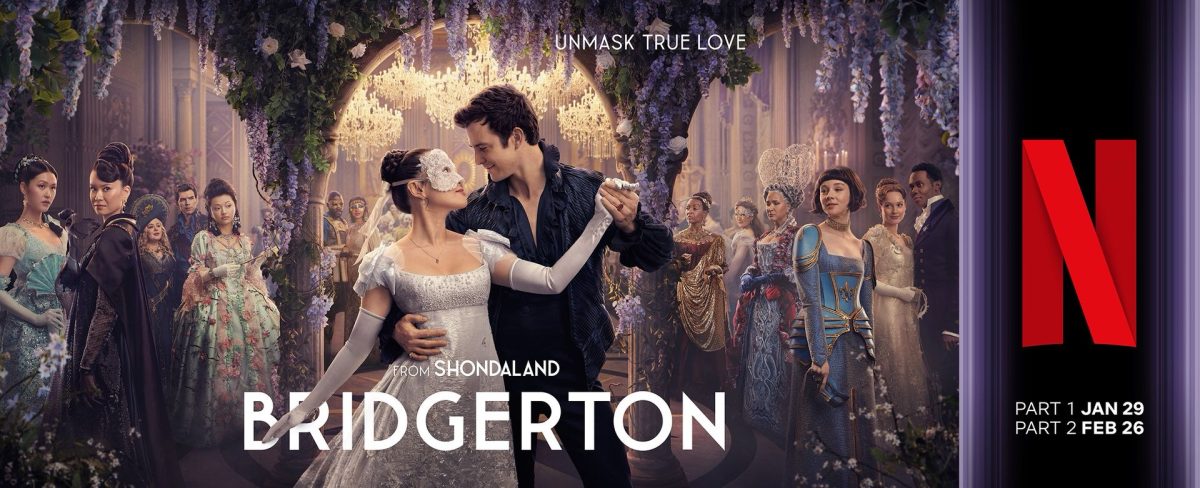
Netflix’s popular period drama Bridgerton returned in Jan. 2026 with its fourth season, shifting its focus to Benedict Bridgerton and his long-awaited love story (Netflix Tudum). After seasons centered on Daphne, Anthony and Penelope, fans were eager to see how the show would handle Benedict’s quieter and more artistic character. Season four delivers the familiar beauty and romance that viewers expect, but it also reveals some weaknesses that make it one of the most debated seasons so far.
Season four follows Benedict Bridgerton, played by Luke Thompson, as he meets Sophie Baek, played by Yerin Ha, during a lavish masquerade ball. Their relationship is inspired by Julia Quinn’s novel An Offer from a Gentleman, which loosely mirrors the Cinderella fairytale (People). This storyline gives the season a dreamy and classic romantic tone. Many critics praised the season for maintaining Bridgerton’s signature look, filled with detailed costumes, elegant ballrooms and dramatic musical arrangements. According to Rotten Tomatoes, the season continues to succeed at creating an engaging fantasy world that feels romantic and entertaining, even when the plot is predictable.
However, while Season four is visually impressive, it struggles to feel new. Several reviewers noted that the storyline follows a familiar pattern that longtime viewers have already seen multiple times (TechRadar). Forbidden romance, secret identities and social barriers have all played major roles in past seasons. While these tropes are central to the show’s identity, Season 4 does not always offer a fresh perspective on them. Compared to earlier seasons, which explored strong emotional growth and character development, this season sometimes feels safe and repetitive (The Independent).
Audience reactions reflect this divide. According to Forbes, Season four currently holds the lowest audience score of the series on Rotten Tomatoes. This does not mean the season is unsuccessful, but it suggests that viewers expected something more innovative. Previous seasons raised the emotional stakes by showing personal struggles, family pressure, and changing social expectations. Season four, by comparison, often relies on familiar romantic tension rather than deeper emotional conflict.
Much of the discussion around this season focuses on Benedict himself. Benedict has always been portrayed as creative, independent and different from his siblings. These traits made many viewers hopeful that his season would break away from tradition (Netflix Tudum). While the show highlights his artistic side, some critics argue that Benedict does not fully evolve as a leading character. The San Francisco Chronicle notes that Benedict sometimes feels overshadowed by the larger ensemble, making it harder for his personal journey to stand out.
Sophie Baek’s character brings important class issues into the story. As a woman working as a maid, Sophie experiences the harsh realities of social inequality. The season touches on these struggles, but some viewers believe they are not explored deeply enough. While the show presents moments of hardship, it often moves quickly back to romance, leaving less room for reflection on class divisions (Business Insider).
Despite these criticisms, season four has sparked meaningful conversations. One positive change from the novel is how the show handles consent and power dynamics. Critics from Vanity Fair and Business Insider praised the adaptation for removing or softening problematic elements from the original story. This shift reflects the show’s effort to adapt historical romance for a modern audience.
Representation also remains a major topic. Some critics from them. argue that while Benedict’s bisexuality is acknowledged, it is not fully explored once the main romance begins. This has led to discussions about how representation is included and whether it is treated as central or secondary. These debates show that Bridgerton continues to influence conversations beyond entertainment.
At the same time, many viewers still enjoy season four for what it is. Time describes the season as comforting and enjoyable, especially for fans who appreciate escapist television. The romantic tension, humor and dramatic reveals remain engaging. For many, the show continues to provide a break from reality through its glamorous setting and emotional storylines.
Still, for viewers hoping the series would take greater creative risks, season four may feel like a missed opportunity. The season does not fully push the story forward in new ways, and its reliance on familiar structures can feel limiting. With the second half of the season yet to be released, there is still potential for growth and deeper development.
Overall, Bridgerton season four remains an enjoyable but imperfect addition to the series. It succeeds in maintaining the show’s signature style while falling short of the emotional impact seen in earlier seasons. Grace Fasulo (11) shares, “I think it’s a lot different than the previous seasons, I really enjoy the idea of two different social classes being in love and the presence of tension because of it, but Benedict quickly needs to get his act together for me to continue to enjoy it.”
Whether viewers see season four as comforting or disappointing, often depends on whether they value consistency or innovation more. Either way, the season proves that Bridgerton remains culturally relevant, even when it struggles to reinvent itself.