Censorship is often imagined as something obvious, such as books being banned or reporters being arrested for speaking out. While those examples still exist, especially in authoritarian countries, censorship in modern journalism has become far more subtle. Today, it is often hidden within algorithms, corporate ownership, editorial restrictions and financial survival. As a result, journalism may still look free on the surface, even when important voices and perspectives are quietly limited.
Globally, censorship remains a clear and documented issue. According to Reporters Without Borders, press freedom has declined worldwide for several consecutive years, with journalists facing increasing political pressure, legal threats, and economic control (Reporters Without Borders, 2025). In some countries, governments directly restrict what can be published, but in others, censorship happens indirectly through funding cuts, media consolidation or intimidation. This matters because global journalism shapes international narratives, and when reporters cannot speak freely, public understanding suffers.
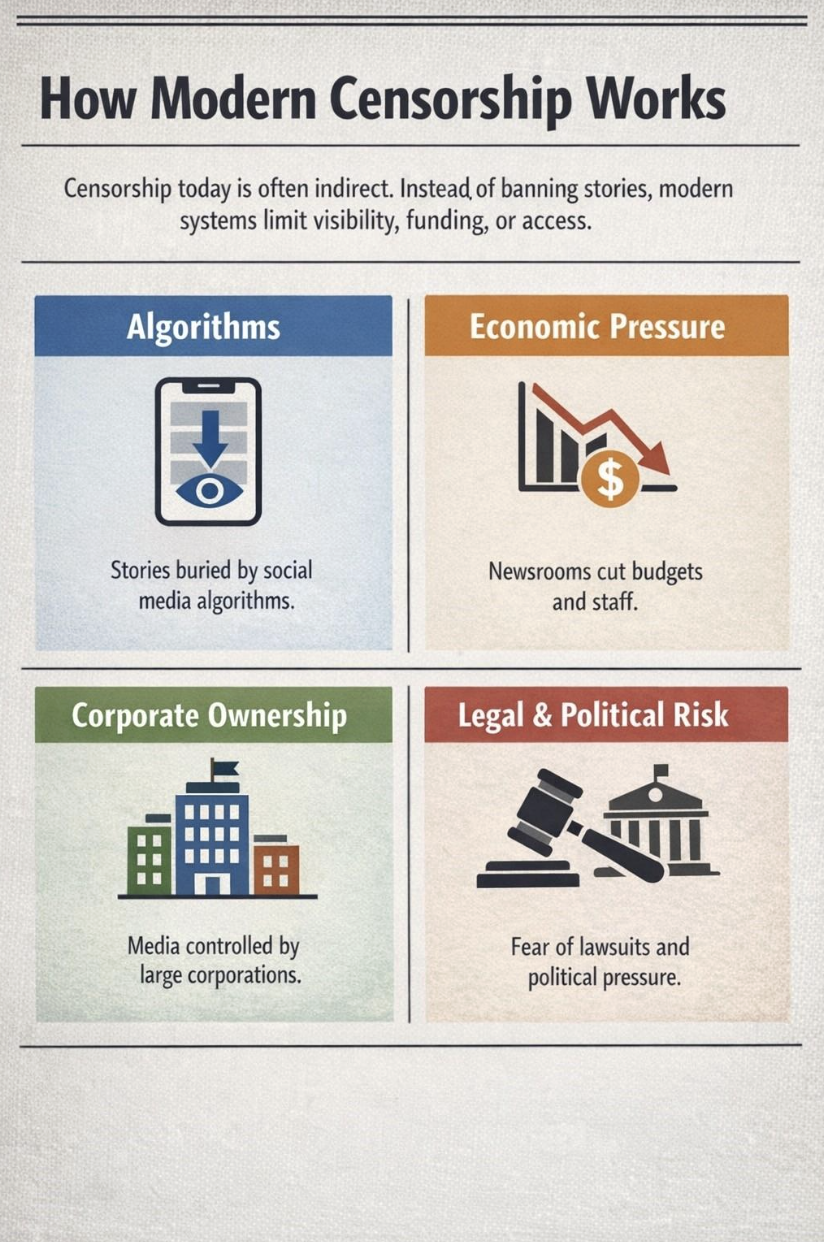
In the United States, censorship rarely takes the form of government officials shutting down newsrooms. Instead, it often appears as constraint. Journalists must navigate defamation laws, advertiser concerns, ownership interests and audience backlash. These pressures can discourage writers from fully exploring controversial topics. While this is not always intentional censorship, it still limits how much truth can realistically be told. When journalists fear legal or financial consequences, silence can feel safer than honesty.
Digital platforms have also transformed how censorship functions. Most Americans now encounter news through social media feeds rather than newspapers or television broadcasts. Pew Research Center reports that platforms such as Facebook, Instagram, TikTok and X play a major role in determining which stories gain visibility (Pew Research Center, n.d.). Algorithms prioritize engagement, not importance. Stories that challenge power structures or lack viral appeal can be buried, even if they are accurate and relevant. This creates a system where information is not banned, but effectively hidden.
Economic pressure is another major driver of modern censorship. Newsrooms across the country have shrunk due to declining advertising revenue and subscription fatigue. Pew Research Center has documented long-term declines in newsroom employment and newspaper circulation (Pew Research Center, n.d.). With fewer reporters and tighter deadlines, editors may avoid complex investigations that require time and resources. In these cases, censorship is not enforced by authority, but by scarcity.
Corporate ownership further complicates journalistic freedom. Many major media outlets are owned by large corporations with financial and political interests. While ethical journalism standards still exist, reporters may face unspoken boundaries about what topics are encouraged or discouraged. Columbia Journalism Review notes that dependence on large advertisers and platform partnerships can influence editorial decision-making, especially when outlets rely on those relationships to survive (Columbia Journalism Review, 2023). This can make journalism feel filtered, even when no official rules are written.
Public trust plays a role as well. According to Gallup, American trust in mass media is near historic lows (Gallup, 2025). When audiences believe journalism is biased or incomplete, they often turn to alternative sources that may lack verification or accountability. Ironically, this distrust can push journalists to be more cautious, not more honest, as they try to avoid backlash. This feedback loop can reinforce the feeling that the full truth is never told.
“I think that journalism has always been a freedom of speech, but recently everything has become too sensitive,” Danielle Nissim (10) says, “If I’m being completely honest, I’ve seen so many people create problems out of simple things so that leads to the censorship that everyone now must follow. Journalism shouldn’t have limits especially because it was made to push limits and be opinionated. The sensitivity that we can’t say the word rape or shooting and replace it with grape and pew pew is ridiculous to me. Things should be called as they are and if it’s uncomfortable it should be because it’s not meant to be.”
It is important to recognize that not all editorial limits are censorship. Editors exist to ensure accuracy, fairness and legal responsibility. However, when limitations consistently prevent journalists from expressing well-supported perspectives or investigating powerful institutions, the line between responsibility and restriction becomes blurred. The issue is not whether journalism is completely censored, but whether it is increasingly shaped by forces that limit transparency.
The reality of modern censorship is uncomfortable because it does not always announce itself. It exists in what is left unsaid, what is deprioritized, and what is deemed too risky to pursue. For students consuming news today, media literacy matters more than ever. Understanding how information is filtered allows readers to question not just what they see, but what they do not.
Journalism is not disappearing, but it is changing. Whether it becomes more transparent or more constrained depends on public demand, financial support and a willingness to protect press freedom in all its modern forms.