
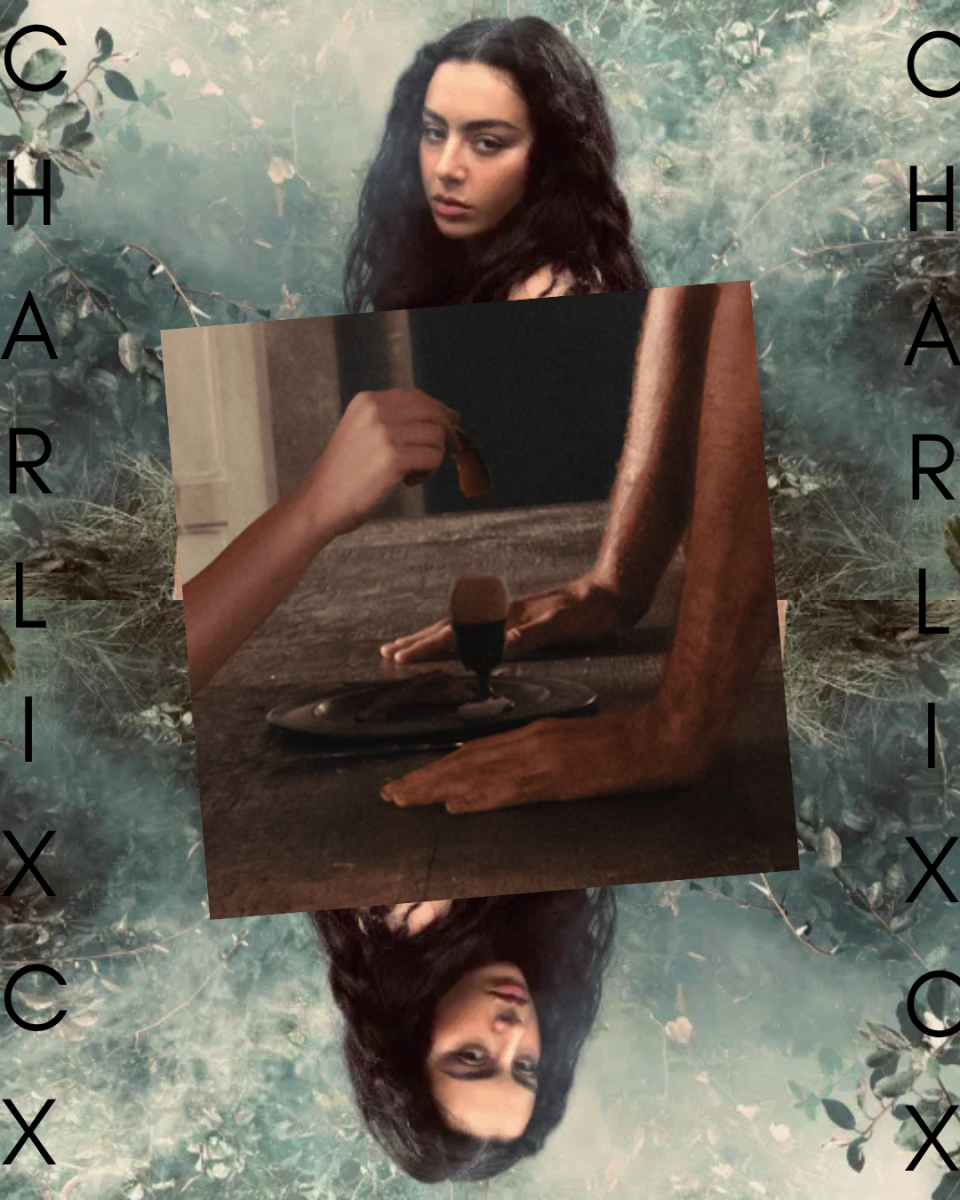
On Feb. 13, 2026, renowned experimental pop star and club DJ Charli XCX released a new album to accompany the film Wuthering Heights. I haven’t seen the movie yet, so I can’t speak to how the music functions within its narrative context. Still, even completely severed from the film it was created for, the album stands confidently on its own. It feels like an assured and ambitious follow-up to the cultural phenomenon that was “brat summer” in 2024.
Wuthering Heights shows major artistic growth for Charli. The project both cements her back into the electropop and hyperpop scenes she emerged from and pushes her into bold new sonic territory. Despite the experimentation, the album never loses its identity. It is unmistakably hers. “The thing about her that I love is that she has this sound to everything she makes, where you can just tell it’s her,” said Katie Arnold, 12. “It separates her from all the other normal ‘pop star girls,’ in a way, since it just makes her music so distinct and iconic.”
That ability to remain “Charli-like,” even while exploring unexpected sounds, is clear from the very first track. “House,” which serves as both the lead single and opening song, begins with nothing more than an out-of-tune violin screeching into stark silence. It is uncomfortable and eerie. Then, unexpectedly, John Cale — a former member of The Velvet Underground — delivers a spoken-word poem. He calls himself a “prisoner,” lamenting how the world he once wished for has failed to become perfect.
As the strings build toward a climax, the song suddenly erupts. Cale and Charli shout, “I think I’m gonna die in this house,” before she continues the line alone, repeating it over increasingly distorted production. Synths and violins blend into something that borders on industrial rock, at moments recalling the abrasive textures of Nine Inch Nails. For a brief, explosive stretch, Charli screams over rising strings while her voice morphs into something jagged and synthetic. It is chaotic, theatrical and completely gripping. If there is any single track that proves how much room she still has to evolve, it is “House.” It is easily one of the boldest songs she has ever released.
That said, while “House” may be the most adventurous track, it does not overshadow the rest of the album. The project as a whole frequently calls back to earlier phases of her career, particularly her hyperpop experimentation during the era of Pop 2, though now with noticeably sharper production and more emotional clarity. The foundation of the album is hyperpop, but it is polished and purposeful rather than chaotic for chaos’ sake.
“Dying for You” is a standout example. It highlights how effortlessly catchy Charli can be while still leaning into glitchy production and unconventional structure. The hook is immediate, sticky and undeniably hers. It feels like a refined version of the boundary-pushing tracks that defined her earlier work.
The album is not afraid to shift tones, either. “Chains of Love,” one of the record’s biggest songs, leans heavily into ballad territory. It has already become a fan favorite for precisely that reason. “She doesn’t do songs like this often, so it’s nice that we got such a good one from her like this, since her slower songs are always some of her best,” said Dakota Corbin, 9. The track strips away some of the hyperpop intensity and allows her vocals to take center stage, revealing a softer but equally compelling side of her artistry.
Other notable tracks include “Always Everywhere” and “Wall of Sound,” the album’s additional singles. “Always Everywhere” is another slower moment, this time more minimal in its instrumentation. The production largely rests on a simple synth pattern, leaving space for her voice to carry the emotional weight. Without heavy layers to rely on, she proves she can control her vocals well enough to communicate something raw and visceral.
“Wall of Sound,” meanwhile, blends orchestral strings with some of the most personal lyrics she has written. The track builds gradually before landing on the striking closing line: “Love and hatred and I can’t escape it.” It feels reflective and self-aware, almost like she is acknowledging the pressures that come with being both critically praised and constantly scrutinized.
Perhaps the most interesting aspect of Wuthering Heights is what it represents for her legacy. Many listeners questioned whether she could follow up the success and cultural dominance of Brat. That album felt like a defining moment — the kind that can be difficult to surpass or even match. Yet this release challenges the idea that she peaked. “Everyone loved Brat, obviously, but I really didn’t think she would be able to follow that up, until she actually did,” said Chloe Jonas, 9.
In an interview with NME, Charli admitted that after finishing Brat she “had this feeling that I wouldn’t be able to make music anymore.” That sense of uncertainty makes Wuthering Heights even more significant. Rather than sounding drained or creatively exhausted, she sounds revitalized. The challenge of crafting a soundtrack appears to have pushed her into new territory instead of boxing her in.
If anything, the album suggests that her creative drive has intensified. She has not abandoned the experimental instincts that built her career, nor has she retreated into safe, predictable pop formulas. Instead, she has balanced risk with refinement. The result is a project that honors where she came from while boldly expanding where she can go next.
Even without the context of the film, Wuthering Heights stands as a powerful statement. It proves she is capable of evolution without losing identity. It answers doubts about her ability to follow up a career-defining moment. Most importantly, it shows that Charli XCX is far from finished redefining what pop music can sound like.
Score: 9/10