
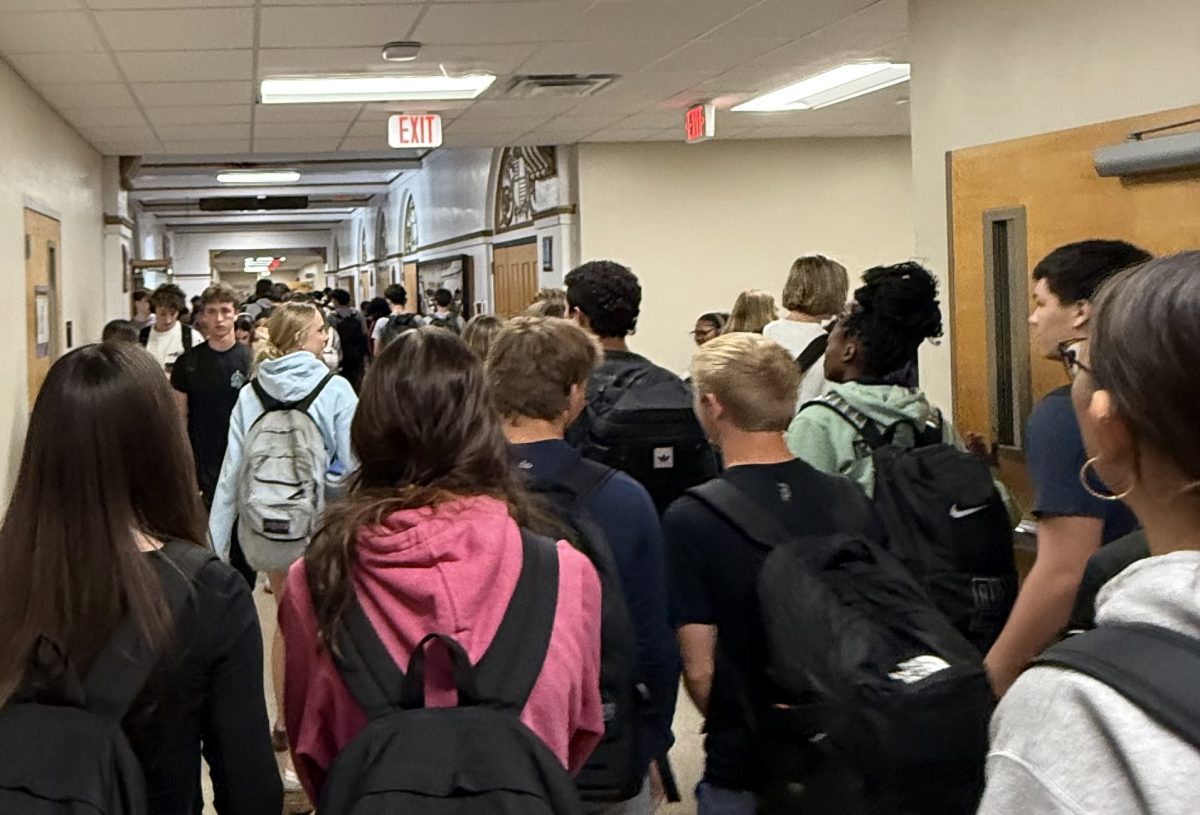
Imagine the following scenario: the bell marking the end of class rings, and within a couple seconds, the hallways are packed with students. What was once a calm corridor becomes the exact opposite in an instant. Backpacks collide, shoulders bump into each other, and the crowd becomes a congested maze to navigate.
This situation is simply a part of Plant High School’s everyday life. It also raises a broader question. Why does the school feel overcrowded?
“Every corner and staircase is like a congested maze, having to twist and turn and wait for lines of people to pass in front of me,” Oliver Habiyakare (12) says.
While this experience shows the typical reality of a Plant High School student, the answer to the earlier question runs much deeper. Originally constructed in 1927, the school was built to accommodate around 1,400 students. The population of Tampa was around 60,000 people. In 2026, the same number sat around over 400,000. As the population grew, so did the demand for Plant High School’s hallways.
While history plays a part in this matter, the school’s location plays as just an important role. Due to its proximity to Himes Avenue and Dale Mabry Highway, the school occupies a relatively small plot of land with little room for expansion. The result is crowded halls, making them a defining feature of Plant High School’s experience.
As of 2026, there are almost 2,500 students at Plant High School. This is almost 1,100 students beyond the maximum the school can accommodate. The result is obvious: even routine tasks, like getting to class on time, become more difficult to complete or even handle.
“When I’m a tad bit late to class, the teacher marks me late. Also, to other students as well, just adding to the problem,” Marcus Harris (12) says.
With only five-minute passing periods, some students are forced to walk across campus just to get to their next class. This task becomes nearly impossible to grapple with when crowds of students are heading in the same direction.
There is also one main indirect consequence of these crowded hallways, and that has to do with psychology. When people are exposed to crowded or claustrophobic areas, their brains can become easily overwhelmed by constant noise, movement and visual stimuli—a phenomenon commonly referred to as sensory overload.
This phenomenon can also affect stress. The simple tasks mentioned earlier like getting to class on time can feel exponentially more stressful when considering sensory overload. The pressures to navigate congested hallways under time constraints can easily amplify feelings of frustration or anxiety. The unfortunate reality though is that many students have become used to such conditions.
Over crowdedness at Plant High School is more than just a minor inconvenience; it could also burden students with mental fatigue or constantly changing stimuli, making movements across campus exhausting. It also clearly highlights the urgent need for solutions that can improve the everyday life of a Plant High School student.
Design by Ayaan Gupta