For many juniors, taking AP classes is considered a rite of passage in high school. It is considered a college-level class not only because it can boost a student’s GPA but also because it can give students college credit. Nevertheless, there are some challenges associated with AP classes. Although all students have unique experiences based on their talents and interests, some AP classes are definitely tougher than others. Below is a list of the five most commonly taken AP classes by high school juniors, from toughest to least challenging: AP U.S. History, AP Biology, AP Calculus AB, AP English Language and Composition and AP Psychology.
AP U.S. History
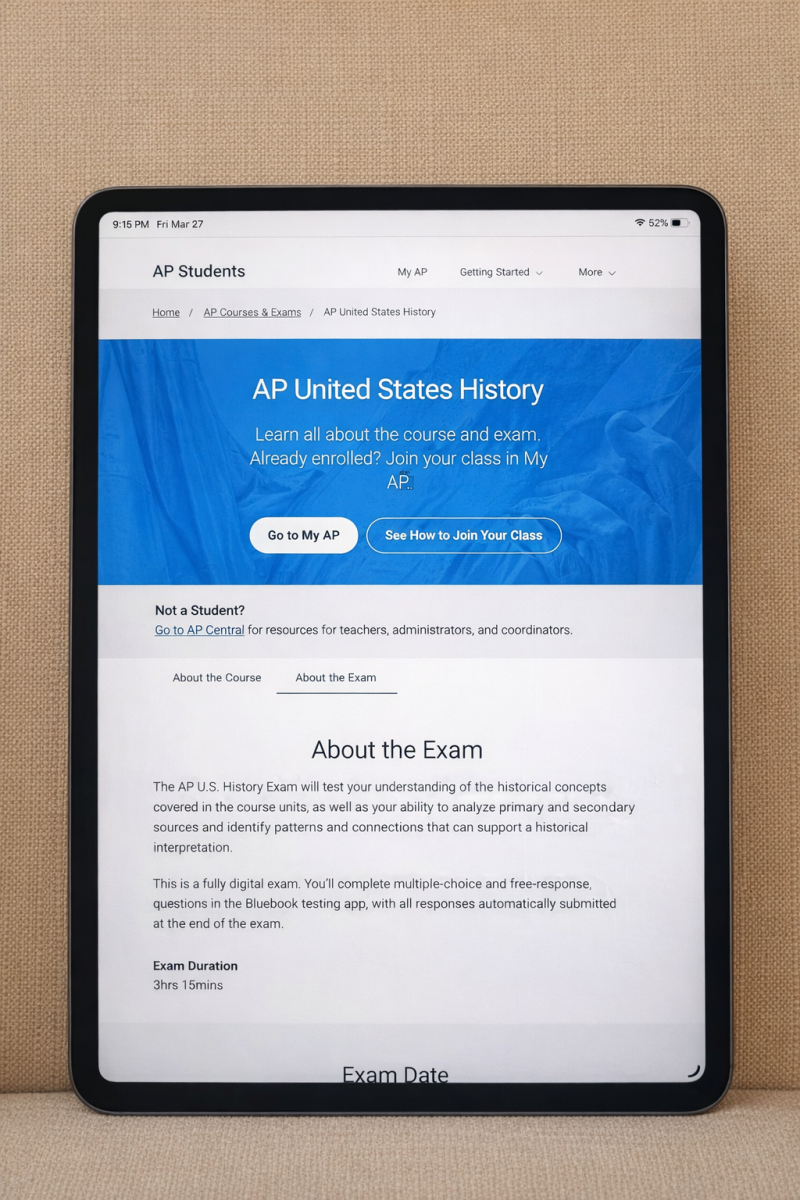
The first is AP U.S. History, commonly known as APUSH. APUSH is considered one of the toughest classes for a student to take. The reading level for this class is extremely high. It is also taught at a very fast pace. In addition, critical thinking is a must for this class. Like any other class, memorization is key. APUSH requires a critical understanding of cause and effect, continuity and change and argumentation.
“APUSH takes a lot of studying compared to other classes,” Aubree Mann (12) says. “I probably spent two hours a day, so around almost 10 hours a week studying. If I were to give advice to someone thinking about taking the class, I would say just keep up on the reading and don’t fall behind, or else it’s very hard to catch up. Just stay committed to it.”
AP Biology
Right behind it is AP Biology, which is also considered to be a class that is extremely challenging to learn in the first place. This is because not only are students expected to learn complicated scientific ideas, but they are also expected to learn the ideas that accompany the experiments conducted in class. It is extremely challenging to learn about cells, genetics and evolution, even for the brightest minds.
“I think the workload is more about memorization and connecting units to each other,” Avery Schmelzer (12) says. “I would recommend AP Biology to juniors because it helps you understand how life actually works on a deeper level, from cells and DNA to entire ecosystems. The class challenges you to think critically rather than just memorize information, which is useful for college and other AP classes.”
AP Calculus AB
The next course in the series is AP Calculus AB, which introduces the world of college-level math. To a non-mathematically inclined person, this course may be extremely challenging. In AP Calculus AB, there is a lot of practice, and a good grasp of the fundamentals is necessary. Although the course makes perfect sense, if a single day of class is missed, it is extremely difficult to keep up. Compared with the other two courses, this one is well-organized.
“Daily practice is extremely important for success in AP Calculus AB because each concept builds directly on the previous one,” Charlie Nash (12) says. “Topics like limits, derivatives and their applications are all connected, so falling behind even slightly can make new material much harder to understand. Compared to previous math classes, AP Calculus AB is generally more demanding and conceptually focused. For students considering taking AP Calculus AB, the best advice is to stay consistent, ask questions early and not get discouraged if the material feels difficult at first.”
AP English Language and Composition
The AP course in English Language and Composition ranks fourth. This course is a bit easier, but it is still hard. This is because it is a skills-based, not a content-based, course. In this course, students learn to analyze and write essays, among other things. How hard this course is depends on a student’s writing skills and how well they can write. There is reading, but it is not as overwhelming.
“AP Lang takes a lot more work compared to my other English classes, but the format is mostly the same,” Carmel Schatz (12) says. “I spent about two hours reading and writing weekly, but the most important part was practicing because the more you do it, the more comfortable you get with it.”
AP Psychology
Finally, AP Psychology is one of the easiest of these five classes, though it is by no means easy. It is a class focused on understanding human behavior and psychological theories. While it is true that a lot of vocabulary and knowledge must be learned, this is one of the more straightforward classes compared to the others listed.
“AP Psych is mostly about memorization, specifically the vocab,” Palmer Stringer (12) says. “I would say it’s a little easier than the other AP classes, if you have a good memory.”
It is also important to note that “difficulty” is relative. A student who excels in the sciences may find AP Biology easier than AP English Language and Composition, while the reverse may be true for a student who excels in writing.
At the end of it all, the choice to enroll in AP courses is not about finding the easiest route, but about challenging oneself in the academic world. It may be struggling through APUSH readings or excelling in derivatives in calculus, but students are being given essential tools for their future success.
Design by Megan Canady