
In recent years, Hollywood has increasingly relied on remakes, reboots, sequels and adaptations rather than creating entirely new stories. From Disney live-action remakes to television adaptations of existing franchises, audiences are seeing familiar stories retold again and again. Some viewers enjoy revisiting stories they already love, while others argue that this trend shows a lack of creativity in the film industry. The rise of recycled media raises an important question: Is Hollywood out of original ideas, or are studios simply making safer financial decisions?
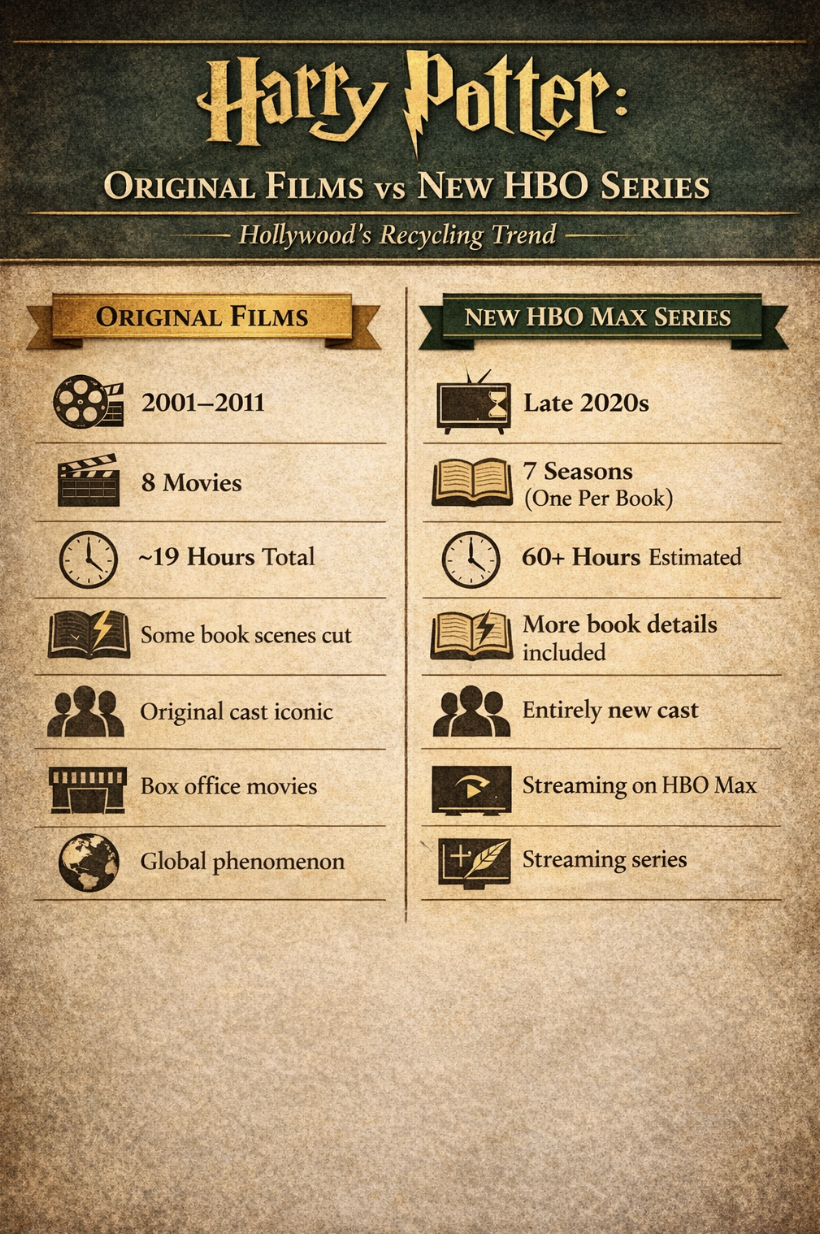
One major example of this trend is the upcoming HBO Max television adaptation of Harry Potter. The original film series ran from 2001 to 2011 and is still widely popular today. Because the movies are relatively recent and already successful, some fans question why the series needs to be remade instead of expanding the universe with new stories, such as a series about the Marauders, a group of characters frequently discussed within the fandom. This reflects a larger pattern in Hollywood where studios revisit successful franchises instead of investing in new ideas. According to research on film production trends, studios often choose familiar intellectual property because it reduces financial risk and increases the likelihood of profit (McDonald & Wasko, 2008).
Disney has also contributed heavily to this trend through its live-action remakes of animated classics such as The Lion King, Aladdin, Beauty and the Beast and The Little Mermaid. These films often earn large profits at the box office despite mixed reviews from critics. This suggests that audiences are drawn to nostalgia, which studios can use as a marketing strategy. Nostalgia plays a powerful role in entertainment consumption because audiences already have emotional connections to the original stories (Grainge, 2000). As a result, studios may prioritize familiar stories over new ones because they are more likely to attract audiences and generate revenue.
Romantic comedies are also being revisited and remade, including films like 13 Going on 30, even though the original film was released only in 2004. Some critics argue that remakes are more understandable when older films are updated for new generations, but remaking relatively recent films raises questions about whether the industry is experiencing a creative slowdown. Film scholars have noted that Hollywood often cycles through periods where studios rely more heavily on sequels and remakes, especially when financial risk is high or the industry is uncertain about audience preferences (Schatz, 1993).
Another criticism of remakes and adaptations is that they often do not add anything new to the story. Many fans argue that if studios are going to remake a film or adapt a book again, they should include scenes, characters or details that were left out of the original adaptation. Without new content, remakes can feel unnecessary or repetitive. However, others argue that new adaptations can allow for more accurate storytelling, especially when adapting long book series into television formats rather than films.
“I feel like on a very rare occasion, only when Hollywood recycled media or movies actually turn out well, do I support it, but nine times out of 10 it usually doesn’t, and it’s just a disappointing series of remakes recently,” Julianna Margre (11) says. “Disney remade Malcolm in the middle into a sequel, and as I rewatch it as a fan of Malcolm in the Middle, I was disappointed by the remake.”
From a business perspective, the trend toward recycled media makes sense. Producing movies is extremely expensive, and studios want to invest in projects that are likely to succeed. Known franchises already have established fan bases, built-in marketing appeal, and recognizable characters. According to the Motion Picture Association, global box office revenue depends heavily on franchise films and sequels because they consistently perform well financially (Motion Picture Association, 2023). This suggests that Hollywood’s reliance on existing stories may be driven more by economics than by a lack of creativity.
However, some critics argue that this focus on franchises and remakes limits opportunities for new writers, directors, and original storytelling. When studios prioritize familiar stories, fewer original films may be produced. This could lead to less innovation in filmmaking and storytelling over time. The film industry has historically gone through creative cycles, and some experts believe that periods dominated by remakes are often followed by periods of new ideas and innovation (Schatz, 1993).
Overall, the trend of Hollywood recycling movies and television concepts can be viewed in two ways. On one hand, it may suggest a slowdown in original storytelling and creativity. On the other hand, it may simply reflect the financial realities of the film industry, where studios invest in projects that are most likely to succeed. Whether audiences see remakes and adaptations as exciting or unnecessary likely depends on how much new content and creativity are added to these projects. If studios continue to remake familiar stories, audiences may begin to demand more originality in the future.