

In recent years, feminism has become one of the most widely discussed and debated social movements, especially among younger generations. Originally centered on achieving equality between men and women, modern feminism has expanded in both influence and interpretation. While many still view it as a necessary movement for fairness and rights, others argue its message has been distorted in some spaces, shifting from equality toward ideas of superiority or resentment. Understanding both perspectives is important in order to evaluate what feminism represents today.
At its core, feminism is defined as the advocacy of women’s rights based on equality of the sexes. UN Women describes feminism as a movement focused on equal rights and opportunities. Historically, feminist movements have played a major role in securing rights that many people today may take for granted. Women in the United States gained the right to vote in 1920, and laws protecting women from workplace discrimination were not firmly established until the late 20th century, according to the National Women’s History Museum. More recently, protections against gender-based violence and workplace harassment have continued to evolve. These facts highlight that feminism has been essential in shaping modern society.
However, despite its historical importance, the perception of feminism has become more complicated. A study by Pew Research Center found many Americans support gender equality but feel disconnected from the term “feminism.” This suggests that while the values of feminism are widely accepted, the way the movement is presented can sometimes create confusion or division. Some critics argue that certain interpretations of modern feminism promote hostility toward men or focus more on power than equality. While this does not represent the movement as a whole, these viewpoints have contributed to a growing divide in how feminism is understood.
One major factor influencing this shift is social media. Platforms such as Instagram, TikTok and X allow ideas to spread quickly, but they can also oversimplify complex topics. On social media, feminist messages are often reduced to short phrases or viral trends, which can sometimes misrepresent the original goals of the movement. Content that emphasizes dominance or revenge may gain attention because it is more dramatic, even if it does not accurately reflect feminist principles. This can lead to what some describe as “toxic femininity,” where empowerment is confused with superiority rather than equality.
At the same time, it is important to recognize that feminism is not a single, unified belief system. There are many different branches and perspectives within the movement, each focusing on issues such as race, class or global inequality. This diversity can be both a strength and a challenge. It allows feminism to address a wide range of issues, but it can also make the movement harder to define clearly.
Despite criticisms, feminism remains highly relevant today. Around the world, women still face significant inequalities in education, pay and political representation. The World Bank reports that women globally have about three-quarters of the legal rights afforded to men. In the United States, debates over reproductive rights and health care access continue to shape national conversations. These ongoing issues demonstrate that the fight for gender equality is far from over.
“Even if people disagree on what feminism looks like now, equality is still something that hasn’t been fully reached,” Addison Lee (11) says.
Ultimately, the discussion around modern feminism reflects a larger question about how social movements evolve over time. As ideas spread and adapt to new generations, they can change in both positive and negative ways. While some interpretations of feminism may stray from its original purpose, this does not erase the movement’s importance or its contributions to society.
For students today, understanding feminism requires looking beyond social media and considering both its history and its current impact. It is possible to support gender equality while also questioning how certain messages are presented. By doing so, individuals can form their own informed opinions rather than relying on simplified or extreme portrayals.
In conclusion, modern feminism exists in a complex space between progress and misinterpretation. While it has been shaped by social media and changing cultural attitudes, its core goal of equality remainssignificant. Recognizing both its achievements and its challenges allows for a more balanced and thoughtful understanding of what feminism means today.
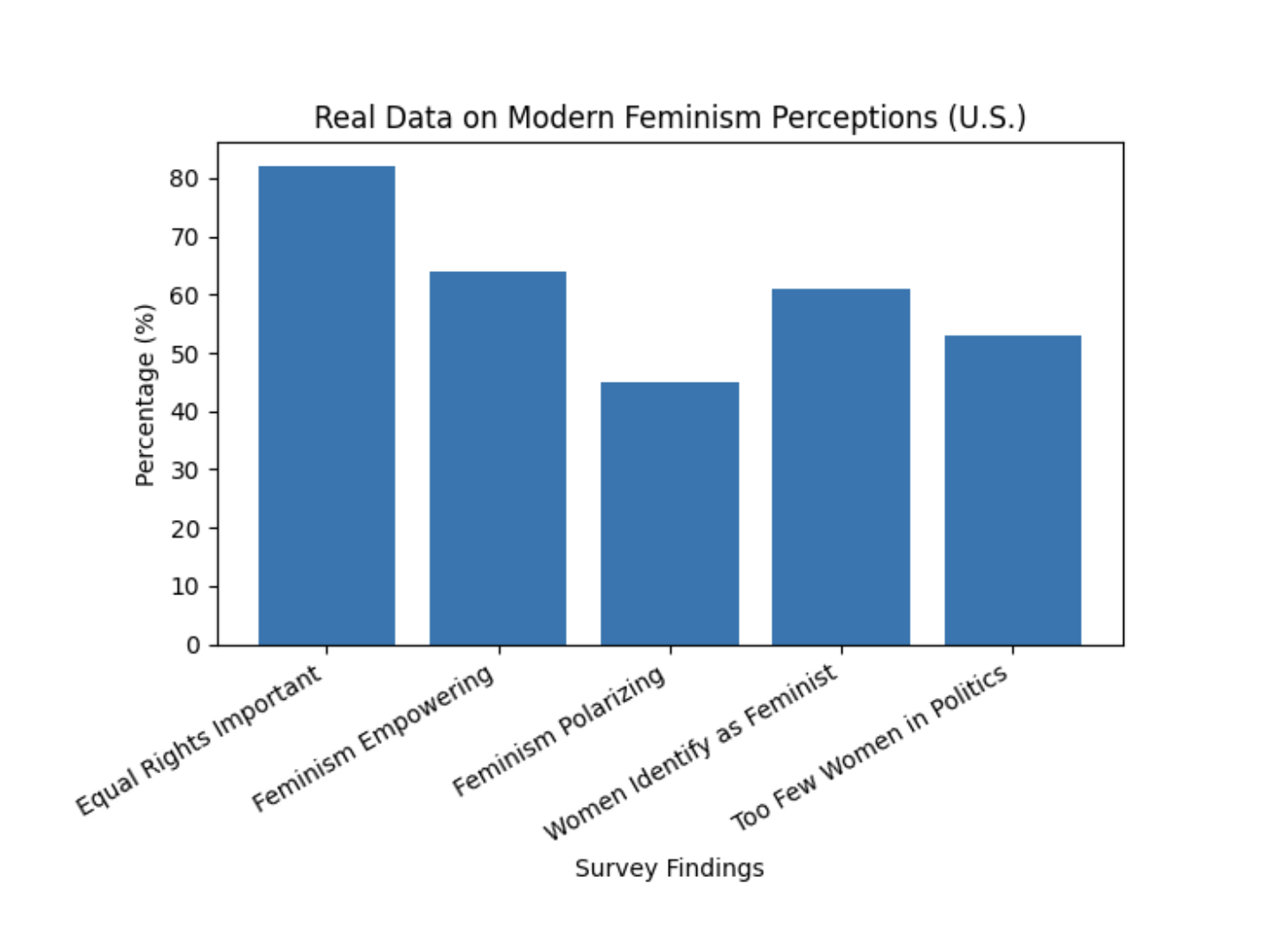
Public perceptions of modern feminism in the United States based on national survey data. Results show strong support for gender equality alongside mixed views on feminism’s modern image.